

Audio Books
Audio Books

Other Articles:
From Conflict to Healing |
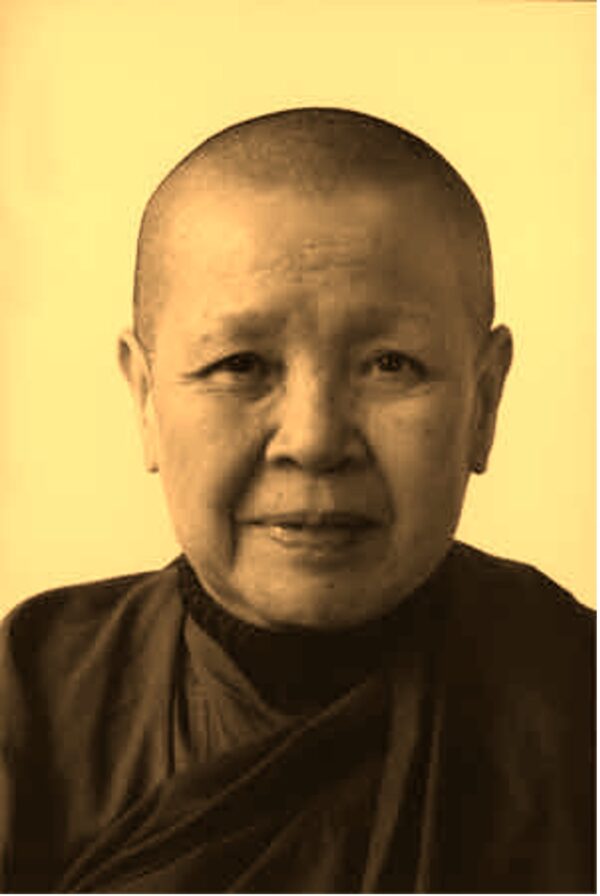
Ajahn Bodhipala, formerly known as Renée Pan, came to Amaravati shortly after offering his life to the Buddha as a nun – abdicating political and social work in his home country of Cambodia, and having previously left his children already raised and a successful career in America. For a decade she has been a member of the community of nuns of Amaravati. What follows is a condensation of several conversations that Ajahn Bodhipala had with the FSN [Forest Sangha Newsletter].
Born in Vietnam to a Vietnamese mother and Cambodian-French father in the borderless interior of French “Indochina”, Renée, then 12, makes the heartbreaking choice to ask to separate from her mother in Vietnam and join her paternal relatives for a new life in Cambodia.
“Can I go to Cambodia?”
Why did you ask to go? I failed the exam to get into high school. At the time, my aunt and husband from Cambodia came to visit our family for the first time since I was born, and I asked to go with them. I wanted a new start. I wanted a higher education. I wanted to have curly hair – with them I would have the opportunity of a new life.
My family was poor compared to our relatives in Cambodia. My father was self-employed; He had a bicycle shop, then became a taxi driver. His parents had died when he was little and he had been sent to relatives in Vietnam, where he met my mother. My father was the breadwinner and my mother made sure that we were healthy and well fed, that we behaved well and were well-educated. Every day he asked her:
– How much do you need today?
She replied, for example:
– I need 15 dollars. – And on that day he was taking a taxi with the aim of making that money, no more and no less. If he wanted something extra for you, then maybe he'd run another race.
My father's Cambodian-French sister, Emily, had no children, and had asked my parents' permission to adopt my older sister when she was little. But for some reason my aunt Emily didn't come until my sister was 17. When she went to Cambodia, she got married after a short time. So I was the right person. Having failed the exam, in despair, with no alternative but to leave Vietnam, it was the perfect opportunity for me to ask to leave, as well as for my aunt to adopt me. I asked my mother if I could go. She was very hesitant. It was really hard for her to make that decision. Finally, she had the help of her own mother:
– Let her go, so they can help each other.
And my mom agreed to let me go. She was my heroine: It took a lot of strength to let me pursue a better future.
The night before I left, I slept with her. We both cried. The next morning my father took us by car to the bus station. I said goodbye and saw him through the window until he disappeared. I felt very sad.
In Cambodia, I had to go back to the first year, but after three years I passed the exam for the third cycle with distinction. My foster father was a captain in the army, and we moved in a lot. So, and because I'm a brilliant student, my grandmother's sister suggested that I continue school in Phnom Penh, and live with her daughter, my Aunt Sounareth.
I felt that the Cambodians were my group, and I was very happy. It took me about two years to learn the language, which is completely different from Vietnamese.
In Phnom Penh, I was introduced to aristocratic life, since my Aunt Sounareth's family had ties to the royal family by affinity. I kept my lifestyle simple; I wasn't interested in joining the upper class social scene. Deep down, I felt that only education could transform me into a woman of value and wealth. I studied a lot, and graduated with distinction.
Was your family Buddhist? What was your relationship with religion? In Cambodia everyone assumed that my family was Buddhist because Cambodia is a Buddhist country – around 98 percent before 1975. Although my father's family side was French and therefore Christian, I attended more Buddhist temples than churches. Christians, Buddhists and Muslims all lived in harmony.
Your husband played an important role in your life. How did you two meet? We met in Battambang for the summer break. He was getting ready for the college exam and I was getting ready for the third-cycle entrance exam. Students had to pass a lot of exams! It was just the cream of the cream, the others had to leave school early if they didn't pass. He taught me math. I was 14 and he was 21, he was an excellent student and he had a sweet voice. His father was a well-known monk. From that summer on, Sothi was my boyfriend.
He passed and received a scholarship to study in Japan; I passed and finished the third cycle. He left me with love and an incentive to continue school. We exchanged a lot of letters during that time.
We got married shortly after he came back – seven years after we met. He worked as an engineer and taught at a professional school until he received a scholarship to work on his PhD in the United States. I went there to have a year later, in 1963, after the birth of our first child. We were in Athens, Ohio. While he was at school, I looked after the boy and when I was at school, I looked after him. We returned home in 1969 with two children, another baby on the way and two courses: a PhD in Education and a bachelor's degree in Mathematics.
In 1970 the coup d'état took place and Cambodia was declared a republic. My husband was appointed itinerant ambassador to the African continent and then became Minister of Education. I worked as Director of External Relations at the Ministry of Culture. My life was very busy, with social and political work – it was not as easy as I wanted. With Sothi, my role was to be not only his wife, but also his friend and mother. As his friend, I accompanied him to political meetings and often he asked me for an opinion. At night, before going home, he read the newspapers and made a report, prepared dinner for friends and received diplomats who were visiting.
“Honey, you have to leave.”
Have things become very difficult in Cambodia? Yes, aerial bombardments were constant as the Khmer Rouge approached taking over the country. At that time, Sothi was Deputy Prime Minister, responsible for three ministries. I took the opportunity to help disadvantaged children, women and refugees coming to the city. Phnom Penh was cramming around that time.
When the Khmer Rouge were taking over, the U.S. Ambassador sent a letter to Cabinet members inviting them to leave the site with him within two days. But we were not included: the ambassador knew that my husband would probably choose to stay if he was given a lot of time to think about it. Therefore, we received an invitation by phone just two hours before the evacuation. In a hurry, Sothi prepared our travel documents and I prepared the bags and the children. On the way to the U.S. Embassy, he asked us to leave him first at the Prime Minister's house and sent the driver back to pick me up.
I was surprised when I arrived at the US Embassy to see so many people trying to get in – it was chaos. We waited at the embassy for a while, then boarded a huge helicopter. My driver came back with a note that said: “Honey, you have to leave. I'm staying. When Cambodia is at peace, we will see each other again.”
You never saw him again, you just got that ticket? I received this ticket: “Honey, you have to leave.” He chose to stay and I couldn’t stand the thought of discouraging him. So be it. He couldn't leave. I'm proud of him. I left on April 12, 1975.
There were hundreds of people on the submarine they took us to, and there I met the Minister of Education and the President. We were taken to Thailand, and those of us who were in politics went to the Cambodian Embassy in Bangkok to wait for something to happen and see the news. I tried calling my husband from there. There were a lot of people urging me:
– Why don't you convince your husband that he can't stay?
I stayed in Thailand for two months. Then they took us to Camp Pendleton, California. I had left Cambodia in April and in August I decided to stay in the United States, for the kids to do school. My second child was born when we were in Ohio, so I already had citizenship. That allowed us to get out of the field. I called a close friend at that time to look for my son's birth certificate and as soon as I received it, we left. Some friends at the Summer Institute of Linguistics who my husband had helped set up an English school in Cambodia, knew I had left and then they rushed to ask me:
– What do you need?
I wanted to go back to school. They said:
– All right, we'll help you.
I went to Baltimore to stay with a friend's family. Then friends from the Summer Institute and another friend from the U.S. Embassy made me offers. I had to choose one – they both came at the same time. One was “I have a scholarship for you in North Dakota” and the other was “I have a job for you in Washington DC teaching the ambassadors’ children. Only five or six per class, so you can have your children there too.” I chose education. I went to North Dakota for the purse.
A big change from Cambodia. Oh, a big change. When people hear this, they say: “How did you get there? It's too cold!" Only my suffering… was too deep. I needed to have something to challenge me. Go back to studying and looking for the hardest topic! I worked so hard because I didn't want to have any room in my mind. If I had space, I'd go crazy with the pain of being without it. He's gone. He's gone. I was trying to let go. But every time I worked on a simple task, I couldn't handle it. I had to ask for a difficult task – to keep me thinking all the time. I tried to replace suffering with hard work to fill the void.
I have come to realize that this cannot be done that way. This is where meditation comes in. You have to see the suffering: Meditation allows it to emerge and be resolved right there. But at first I was afraid to experience meditation. I thought: If I start doing meditation and I don't have a good teacher and I get disoriented, who takes care of my children? So I had to be very cautious. I just kept following the Buddhist philosophy of doing good things for others, trusting that good will return to the person. I spoke a few languages, so I volunteered to help other refugees.
I saw him eat carrots
After earning a master's degree in Applied Mathematics from the University of North Dakota while raising her children with social assistance, Renée/Bodhipala worked as a computer programmer and eventually became a senior economics analyst for a group of energy companies. His free time was divided between his children and he helped several refugee communities in North Dakota and Minneapolis, where he later moved, after requesting a transfer to a place where he could help more people. When Cambodian refugees began flowing into camps in Thailand after Vietnam invaded and overthrew the Khmer Rouge, she spent her holidays providing help. The idea of doing meditation was presented to him on his way to Thailand in 1983, at a chance meeting at Seoul airport with Ven. Maha Ghosananda, a notable senior Cambodian monk who was also going to help in the fields.
I saw him sitting around eating carrots, he had them in his bag. I went to him and said:
– Bhante, Is it Cambodian?
We talked a little bit and I asked him:
– Bhante, How do you let go of a thought? It's just that whenever I have a problem that I need to deal with, I think so much that I can't sleep.
He said:
– Meditation!
Since then, I've had meditation in mind. Then he went to the fields, I went to the fields, and by chance we were in the same hotel in Aranyaprathet. So we went together.
The first Cambodians to reach the border had prominent stomachs and yellow hair because of hunger. We walked together. He cried and I cried and we thought about how we could help. Since then, we have worked together almost every year. There were years when I went to the countryside and years when I went to the United Nations in New York to work with the Cambodian President in exile. I was very involved in politics during that period; I even considered putting the kids in boarding school so I could join the freedom fighters in the camps.
At the time I was suffering a lot for the loss of my husband, for not knowing if he was alive or dead, and for not being able to stop hating the Khmer Rouge. I had in mind the idea that I needed to help, and I always did something for the Cambodians in the camps. But I couldn't do more, because my emotional obstruction was the Khmer Rouge. Whenever I wanted to do something, it was as if they were in front of me, and then I couldn't move forward. I could see the Khmer Rouge children in the Khmer Rouge refugee camp. They were so pure, so clean – they were not murderers. They weren't my enemies. Their parents were my enemy. I couldn't forgive them. It's poison. You can't think beyond that.
Due to the suffering I was in, some friends in Minnesota working for an organization called Moral Rearmament, which was set up after World War II to reconcile European countries, invited me to an event. They had a lot of movies, and one of them was Love for Tomorrow, the story of Irène Laure, a recognised French socialist who had been part of the Resistance in World War II, and her son had been tortured by the Germans. Moral Rearmament had invited her to their space in Caux, Switzerland, to talk to German women. She refused:
– How can I be friends with them? They're the ones who hurt my family.
Later, after a little reflection, he changed his mind. She had the opportunity to meet these people and was able to forgive them. Meanwhile the wound was healed, and she began building a bridge between France and Germany for the younger generation.
I saw that movie. Then the file fell on me: She can forgive the Germans. I think I can forgive the Khmer Rouge. It was the first perception of forgiveness. But just as it came, it did. A friend of mine who was there saw me and said:
– Would you like to meet this lady?
I replied:
– Oh, I'd like to meet you, yes.
So they made it possible for me to go to Caux. They paid me an extra vacation and gave me a ticket. I went there to spend two weeks.
Silence is the key
Irène Laure was there. He was 84 years old. One day, it was three o'clock in the afternoon, they took me to have tea with her in the living room. After a while, I asked:
– Madame Irène Laure, what is the key to being able to forgive the Germans?
She said:
– The key for me is to be quiet for a while.
And I asked myself: What is “being silent”? I had a cup of tea with her and then we were done.
I later asked David Channer, who became a great friend at Moral Rearmament:
– David, what is ‘silence’?
– Are you a Buddhist? – He asked.
– Yes.
– It is meditation.
That night I asked my friend who had taken me there to teach me what it was to be “silent”. I knew they were Christians, so I took some texts of Buddhist songs, and she said to me:
– Chooses a passage from the texts and memorises it or retains thought about it.
The difference between that and our meditation is that they have a subject on which they work. We do not, we merely cleanse the mind by observing its own activity.
I did that for several days; I learned to “be silent”, I learned to listen to an inner voice. Then I participated in a workshop called From Conflict to Cure, And forgiveness has come. I saw forgiveness there and I forgave the Khmer Rouge.
I was asked to make a small presentation to everyone about forgiveness. I took it. The night before, he said over and over again: “Khmer Rouge, I forgive you.” And I wrote – I didn’t watch all night because I was so upset about it. He just wrote: “Khmer Rouge, I forgive you for everything you have done.” Then I would tie up the paper and throw it away, one after another. Until the end of the night came and I wrote: “Time is running out.” And I suffered, my heart suffered a lot. And then, in doing so, I saw that the Khmer Rouge … they were not in pain; I'm the one who can't sleep, I'm the one who has a prison inside me. If I can let her out, I can do a lot, and I needed to help my country.
That day I had to speak to the audience. My mind accepted: I have to forgive them. There is no other solution. And from the bottom of my heart came this: Khmer Rouge, I will forgive you for what you did. And in return, I ask you to also forgive me for hating you. In both directions.
It's my turn to talk. I was in front of a lot of people but my voice was not trembling, my heart was beating normally. And he said:
– Here I am in front of you, my friends. I'd like you all to know today that I'm releasing the prisoner from my heart. I will forgive the Khmer Rouge for what they did to my country. And I will ask them to forgive me for the hatred.
Wow! Very strong. People cried. I didn't cry. Then … was very quiet. You could hear a pin drop. And I asked the master of ceremonies:
– Give me one more minute to express what I feel right now, please. – Then he said:
– Thank you very much for relieving me of my burden. – And I felt so warm and so light that I could fly.
“If you ask me, I would kill them.”
When I got home, my son challenged me. He'd be about 20.
– What did you do in Caux, Mom?
– Well, the mother decided to forgive the Khmer Rouge.
What? He jumped up and said,
… I'm sorry to tell you, Mom, but are you crazy? Will you tell those people … to the fathers, to the mothers of the children that they killed before their eyes, throwing them in the air to catch them with the bayonet? And mom tells them to forgive? No way.
I was calm.
– Son, what is your solution? Mom tried to sort things out that way. You don't have to solve them, but what's your solution?
– If you ask me, I would kill them.
– Who would you kill?
– To them.
– Who?
– Pol Pot, the leader of the Khmer Rouge.
– But he is not alone.
– What follows him and what follows …
So many “next and next …” So I said:
– Right now, you are a good person. You haven't done anything yet. Just in your thoughts: How many people have you killed right now?
He started counting and then replied:
– I don’t know what Mom is doing.
But he's changed. A few years later he returned from the Peace Corps after three years of service in Central Africa and loved his mother.
– You were right, Mom. He was right, he said.
Doing this, being able to forgive people for great things, then any conflict you have with others naturally falls away. Even my children, I asked them to forgive me. We used it as a message for the whole family. It helped a lot. And in relation to old friends … I had felt that I could cut with people sometimes. Even the president of the freedom fighters and other politicians with whom I had been annoyed. I asked them all for forgiveness.
I will be your ambassador
In 1987, I was chosen by Moral Rearmament to go to Sri Lanka to do the work of reconciliation between the Singaporeans and the Tamils. Until then I knew my Buddhist roots but didn't have much to do with them. This was the moment when my faith came back. We went to Kandy and they took us inside the Tooth Temple. I made a vow before Master Buddha. Master Buddha, your daughter is here. Please let her know you're here. And as soon as I said it, I was creepy. Then began the piti (Ecstasy) and I cried. Master Buddha, come now and I will be your ambassador. I ask you to empty me of everything that represents bad things, bad thoughts and ill will – everything – I ask you to take it away and replace it with the Dhamma.
When I came back, there was a meditation teacher right in Minneapolis. A friend of mine called me and said,
– We have a very good meditation teacher here. You want to go see him?
His name was Venerable Hem Hom; He was very famous in Cambodia. I made a retreat; It was very intense. It took me five days to see the phenomenon in me. I immediately recognised that the only way I could actually help the Cambodian people was through meditation – it is so powerful that it can be used to alleviate suffering. In that way, I knew that I was in no way dependent on the outside – we can do it alone, we don’t need anything. As simple as that.
The kind of meditation he taught? It wasn't until I came here that I learned that the method he taught me was the Mahasi technique.
Between meeting him and joining the United Nations in 1991, I went through a major transition: Forgive the Khmer Rouge. This freed me from the weight I was carrying with me – I felt my energy popping up as if I had removed a huge blockage. It took two years from the point at which I made the statement to the whole assembly in Caux, until I was fully healed. I set up a project called the Cambodian Children’s Education Fund, with the intention of bringing this message of forgiveness to all camps, of helping the Khmer Rouge refugees as well as the other factions. I wanted to bring reconciliation to Cambodia and reconcile teachers first, so teachers could teach children. I got funding from the United States and other governments. The idea was to prepare the ground for the people before they returned to Cambodia when Vietnam withdrew. While they were in the camps, they could all be gathered together in the same place. I promoted reconciliation between Khmers red and not Khmers red. My wound was healed when I was with them.
Before I went there for the first time, no one could enter the Khmer Rouge camp. I had contact with a Senator in Minnesota, Senator Boschwitz, and with the support of the United States, we went there with the permission of the Thai Government. We were even allowed to bring in the refugees we worked with so they could get to know each other in our homes. workshops – with my life as a guarantee: If they ran away, I'd go to prison.
Together we will rebuild
I went from field to field. We rented cars to transport them. I was scared. I had to travel with Khmers red, while the other members of my group did it with those who were not Khmers red. I didn't think they would dare do anything to me; At least I had a friend as a driver. O workshop It was a government hotel in Bangkok.
How'd it go? Could you trust each other? O workshop It went well. There were about seventy people, including four Cambodian factions. At our first meeting there were about forty teachers sitting in U. The leader of the Khmer Rouge began by saying:
– Today is the first time in ten years that anyone has come to assist our people in matters of education. So we welcome you, for bringing us this kind of help, which is the one we need most. I would like them to help us design a curriculum for our children. Cambodian children must be prepared to fight to the end, to free our country from foreigners. Especially our neighbors.
He went on in this line and I interrupted him.
– Brother, I apologise for interrupting you, but I can no longer listen. These children are very clean. We're teaching you so you can teach the kids. Don't give them our suffering. It's too much. And I'd like you to hear my message. Brother has done so much harm to our country as Khmer Rouge. I hated him, I really hated him, and now I know that hating is wrong. How do I know? It hurt my body. My intelligence was clouded. The hatred was so strong, I wanted to cut you to pieces. That put me through ten years of disorientation. I'm aware of that. Now I ask you to forgive me for hating you. Let me clean up.
After I asked you this, I added:
– And in return, I also forgive you for what you did. To my family: My husband, who I loved so much, is gone. And my relatives. And for turning the country upside down, for turning it upside down. I forgive you, the past is the past. From now on, let's start together. Clean.
We stopped there. As I spoke, I had eye contact with each of them. Some cried, others were just cold. And in the end there were a few ladies who came to me and hugged me, saying:
– I hope that Cambodians from now on can forgive us, like you, so that we can live together.
– Yes. Do your part. I'll do mine. Together we will rebuild Cambodia.
In this way, we were able to move forward and ask them what they needed to help with education. And they all said leadership was needed, which is why the country was a mess. So we set up a leadership program for them. Every year we would go to the camp to help install it, because I did not believe that one could write a curriculum in the United States and try to implement it in Cambodia. We have to do it on the spot.
With ears and eyes open
When the 1991 Paris Agreement laid the groundwork for the Vietnamese withdrawal and so that Cambodia could become a multiparty democracy subject to the authority of a constitutional monarch, Renée/Bodhipala was invited to join the United Nations mission, ATNUC [United Nations Transitional Authority in Cambodia], in charge of overseeing the transition. She then quit her job in Minnesota and worked as an election officer, translator, technician and administrator of IT systems – as well as radio announcer, hoping that if her husband was still alive, he could hear her voice.
You never heard from your husband? No, no. It was very difficult to search because he was very famous. You never know where your questions will end up, whether to an enemy or a friend. I didn't dare give his name to the Red Cross, which was looking for missing persons. But deep down I was looking for him, with my ears and eyes open.
During the run-up to the elections, I volunteered to be a translator in operations across the country, hoping to hear from him. I went with United Nations personnel and worked with the KGB, the CIA, most of the intelligence services, translating the interviews of the Khmers red. Sometimes it was reports of horrific murders. At the end of the day they gathered our testimony: I wasn't supposed to think about it anymore. “You will be in danger if you do not erase it from your mind.”
We also carried out surprise inspections of polling stations in search of fraud. It was dangerous; sometimes they would kill political workers two or three hours before we arrived, or just burn the evidence. We arrived by air, water and land without warning. I've done a lot of things for the country. For example, I set up a computer system to manage military and government payrolls to prevent corruption. It was very gratifying to be able to do something to help my country during that time.
Now, as a nun, this is the best time of my life. I never thought I'd become a nun when the country fell apart. Even when my teacher, Hem Hom, was sick in 1994 and at the hospital he asked me:
– I want you to be ordered. What percentage prevents you from doing so?
I told him I still had responsibilities, that maybe the obstacle was 15 percent. My mind already wanted to be a nun by 85 percent.
I stayed in Cambodia after ATNUC left, working without pay in various areas. I joined my friend Nat Nary, a senior nun from a monastery in Battambang, whose abbess was an excellent meditation teacher, and implemented a project called Mental Health Counselling from there, as she knew the essence of meditation. At that time, Cambodia did not have mental health hospitals; They had been destroyed during the war. The idea was to integrate psychological assistance and meditation in a place where the help of a good teacher would be available. Many mentally ill people came to the monastery for help from the abbess and Nat Nary. A system was created to treat the patients and about a dozen monks and nuns were trained to provide counseling and thus help the abbess to receive more patients.
In 1996, I was invited by Venerable Maha Ghosananda to make a pilgrimage to India. Two or three weeks before we left, I thought: Well, I'm going to visit Master Buddha. What will be the best thing I can offer you? I decided to offer him my hair: become a nun, submit everything to Master Buddha. Therefore, when I came to Amaravati, I was already dressed in white.
Flower, flower, flower,
It was 1997 after the coup d'état in Cambodia. I was very disappointed. I received an invitation from the United States to meet with the Moral Rearmament group. On my return to Cambodia, I stopped at Caux, and David Channer invited me to visit Amaravati. Two months later, he decided to invite Luang Por Sumedho to Cambodia. Luang Por accepted without thinking twice, but I was worried about security; I was afraid they might arrest me at the airport for being so involved in politics. I listened to the news through Voice of America to inform me, but after a while my fear was replaced by the feeling of protection of the world. Dhamma that came from the presence of Luang Por. So I dared to go to Cambodia alone, before the others, to prepare the ground for the visit.
How did you come to live in Amaravati? I felt very comfortable here. I met Ajahn Thaniya and said I wanted to wear brown habits. It just doesn't work that way. Yeah, sometimes it was hard. I was accustomed to a different culture, a different social status; I suddenly found myself in the kitchen and cleaning the bathrooms and everything. However, my faith was so great that I could do anything. And the possible problems of living with different people could easily be forgotten, because my suffering for losing my loved one was so deep, that everything else was on the surface, and it was bearable to me. When there is evidence that he died, one can move on. But when you don't know, how do you deal with it? It's very complicated. But now it's all over. In living with others here, the more we practice the more sensitive we become, and when I see that someone does not show good-will to me, I ask:
– Was I insensitive to you? – And I correct the situation right there, as soon as it happens:
– That was not my intention.
I had to adjust, too. First I was assigned the task of flowers. It was very difficult to do what the nuns wanted me to do in the time available, only in the morning work period – I was using more time because I was not used to it. They told me I wasn't supposed to do that, the afternoon is your time to meditate. It disturbed my meditation. When I sat down, the flowers kept coming to mind. Flowers and leaves of that cor… where I'll put them … and so on. Finally, I ended up using “flowers” as a mantra. Instead of Buddho, only flower, flower, flower – and it worked! My mind has shut up. So I used it when I had something to do: I continued to change my mantra according to what was going on in my mind. The mind clings to something, and to stop it I put that something in a mantra and the mind runs out of time to distract itself.
Did you use the mantra with your attention on the body or on the breath at the same time, or just on the word? I had been instructed to use a word in connection with inspiration and exhalation, and also to repair if anything happened through the doors of the six senses. I continued to create my own mantra, dealing with problems that occur in the mind, until there were no more thoughts. Then, after a few months of practicing here, the sound of silence became my object of meditation. It's so beautiful! At first it was hard to understand, but then I saw that it was very deep.
And you've been using the sound of silence ever since? Since then, I've learned that it's a powerful tool. I use it, except when I'm distracted. When there are problems, I use the mantra again.
I taught my mother to use the sound of silence as well. Before she died, a few problems were solved between us. The first one was that I had stopped communicating with her and the rest of the family in Vietnam a long time ago. They lived with the pain of not knowing where I was, alive or dead. The second was letting my mother assume she wasn't a good mother because she gave me so little.
Before I made contact with my mother and father in Vietnam in 1993, I had not tried to do so, because I hated the Communists and was afraid that writing to them from America would put them at risk. Except my mom didn't think I'd contact her because she hated her for giving me up as a kid. She didn't know she was my hero.
– Mom, you didn’t give it to me, I asked for it. Don't feel bad, because I ended up being a successful woman. I thank you for accepting my request to leave – I told him. And before she died, I asked her for forgiveness.
The first time I came back, I saw that they had a cabin. At that age, and after spending so many years raising nine children, they continued to live in a hut with the sky as its roof. I felt so sad that I built a house for her – a brick house. I've never done anything this big in my life. I didn't own a house myself, but I spent my money making one for them. My parents were very proud. Everyone in the village said:
– It was a daughter What did that do? How do you raise a daughter so that she can do such a thing for us?
My meditation has improved substantially. I'd get rid of regret for not doing things. We do what we can. At my father's funeral, everyone stayed in that huge house. They've never had a house like this before.
“You have to be aware, you know?”
Your mother died just a few months ago. Did you teach him meditation? Yes, yes. I rejected my Vietnamese side and Dhamma It really helped me understand that. I wanted to share that with my mother. I thought: I owe my mother. Because she was my first teacher. What can I do to help her? Two years before she died, I taught her meditation. She was all happy talking about food, about my presence there, listening to old stories. And I decided: You better do something now. I didn't come here to talk about food.
So I went to her bed early in the morning.
– Mom, I'd like to share something with you. Ever since I was ordained, this is what I've been studying. And this is how I prepare my life for death. Do you want to be with Master Buddha?
– Yes! I want to be with him – she replied.
– Mommy, do you hear any sound? – I did not dwell on the explanations. She said:
– Yes, I hear the dog barking, insect noise…
– No, no, no.
There was one last noise she heard.
– Is this the sound of crickets? It has a continuous flow.
And I reposted:
– That's it, Mom. That's it. Listen to me again.
She listened.
– Uau… is continuous. Although very sad. It's monotonous.
– I think it's sad at first, Mom, but the longer you keep listening to it, the better you stay. It's a lot better for you than watching soap operas.
The next day she was excited – she even taught my sister:
– Oh, I want to tell you. It's just that to hear that sound, you have to be conscious. Otherwise you can't hear him. Listen to me! You have to be aware, you know?
I taught her to observe the five precepts, and later to use the mantra. Sugato.
When she died, her entire family was present. It was very quiet. She just closed her eyes, and that's all. I got everyone to chant the mantra she had used: “Sugato, Sugato, Sugato”, the whole division full of Sugato. They were all very attentive, and that's how she died.
It was good to be back – even in Cambodia last year. I passed the vassal in the monastery of meditation in which he had begun. Before coming, my goal was to share meditation with the Cambodian people to help them alleviate their suffering. So I came back to see how things are now. It was the first time in nine years that I had spent so much time away from Amaravati, almost four months. I felt very comfortable here, but I knew it was something I had to do.
Coming back to see my friends who were still working there, I can help them more than when I was a laywoman. At the time I had no new ideas to offer, but with this practice I can offer something new. They may think I'm selfish, but if I'm not at peace here, how can I give peace to anyone? I have to make peace with myself first. And in my case, this way I'm also safer than anywhere else. I'm a nun, so people can see that I don't want anything from anyone. My name was known because my husband was very popular, so people thought I could play an important role in government. They were afraid that I would take their share – something I don’t want. So this is the best way.
So your way of helping the Cambodian people now is simply by practicing the Dhamma? Purely and simply the Dhamma. And not just the Cambodian people. Anyone who comes across me, I basically help her.
It's good for me now as a nun in Amaravati. This is a very good place, turned to practice. I feel a great joy to live here.



 EN
EN  PT
PT