



History
Within Theravada Buddhism is the line ‘The Kammatthāna Tradition (Meditation) of the Forest’, which today, better known as the ‘Thai Forest Tradition’, had as its fundamental milestone the movement inspired and founded by a monk from north-east Thailand in the 20th century, Phra Ajahn Mun Bhūridatta Thera (Phra – in pāli, Venerable). His impulse took a new breath and revitalized the practical teaching of the Buddha, illuminated again the forgotten path to Nibbāna (Nirvāna in Sanskrit) and raised what in ancient cultures was known as the “Wisdom of the Warrior”.
Going back to the past, the tradition of forest meditation goes even further than the Buddha's own time. It was customary to see in these ancient times, in India and in the region of the Himalayas, many who, in seeking the way of spiritual liberation, left the life of the city and village in search of a refuge in the mountain and in the virgin forest. In an act of renunciation of worldly riches and values, this was the ideal place, because the Forest offered a harsh natural space in which the few who could be found there were either the "crazy", the outcasts, or the spiritual renouncers. It was a dimension apart from material influence and cultural norms and thus the propitious site for the cultivation of higher spiritual qualities, which allowed transcending these same limitations.
At the age of 29, Prince Siddhārta Gautama leaves the palace where he grew up and heads to the forest for the purpose of training the disciplines of Yoga. The story is known of how, dissatisfied, he left his masters, looking for his own way. He did so, after which he came to the realization of the essential truth he called ‘The Middle Way’, precisely under the shadow of the bodhi tree, off the Nerañjarā River, where Bodh-Gayā is now located in Bihar State, India.
As far as historical records can confirm, it is reported that, a few months after the Buddha died, supposedly in the 5th century BC, a large Council of Elders was convened to formalise and establish the teachings and monastic rules, in the standard form of the vernacular Pālibhasa – “The Language of Texts.” One hundred years later, the Second Council meets again to verify the whole teaching and to create a general consensus on the code and doctrine. It was then that the great schism and division between the two “vehicles” took place. Most of the group wanted to change certain rules and came to give rise to the Mahāyāna – Great Vehicle, known as North Buddhism, which spread mainly to Tibet (Vajrayāna branch), China, Korea and Japan. The minority of the group were more cautious about the proposed modifications, preferring to remain faithful to the strict simplicity of the teachings and not extrapolate the Dhamma as it had been bequeathed by the Buddha to his original Disciples. It was from this minority group of Theras (in Pāli language – Elders) that 130 years after this “Council”, the Theravada school, Hīnayāna – Small Vehicle, emerged, characterised by being the most conservative, also known as South Buddhism and spreading to the South and Southeast, initially India and then Sri Lanka, Burma, Thailand, Laos, Vietnam, Malaysia and Indonesia.
By 250 BC, during the reign of Emperor Aśoka (§) (273-236), there were already several divergent lines and schools throughout the Indian Sub-Continent. It was then that the third Buddhist Council presided over by Venerable Moggaliputta Tissa Maha Thera met, under the fundamental patronage of the Grand Emperor and where several missions were decided, sent both into and out of India.
In the course of time, there were other missionary groups that dispersed to other Southeast Asian countries, from India and Sri Lanka, such as Burma and later Thailand, Cambodia and Laos.
Despite the geographical dispersion, the continuous retrospection to the standard values of the Pāli Canon was maintaining the central verticality of Tradition, with all the respect and reverence for the way of life and discipline that the Buddha performed in the forest. This Forest Tradition has been the model that has been subsisting despite the many ups and downs over the centuries. Tradition sometimes faded in Sri Lanka and there came monks from Thailand to help her up. Other times it was in Thailand the weakening and there went the monks of Burma to give their breathGo and encourage. This has been the case for centuries, supporting and helping each other, maintaining the original character of ‘religion’ on the surface.
By the mid-19th century, Buddhism in Thailand had acquired a rich variety of regional traditions and practices. However, the general body of his spiritual life had become degraded along with the sloppiness and corruption of monastic discipline, with Dhamma teachings mixed with nebulous tantric and animistic vestiges, allied to the fact that rare were already those who practiced meditation. To make matters worse, there was already a widespread opinion, both on the side of the degenerate fraction and even more so by the "scholars" of orthodoxy, that it was no longer possible to perform nibbāna (Nirvāna), or even reach the initial states of jhāna (meditative absorption).
This was a situation that the revivalists of the Forest Tradition refused to accept. And it was at the same time one of the reasons why they were "catalogued" by independents and agitators by the ecclesiastical hierarchy of the time, in addition to the disdain that many of them showed for the "study monks" of the Theravada line itself by asserting that "wisdom is not taken from books".
This contrast is another crucial point, and precisely the mature ground for something new to emerge. A few, dissatisfied with the current situation, such as the Buddha 2500 years earlier, felt the need to go further. Not neglecting the study of the Canon, they then turned their eyes and their lives again to the wild corners of the forests and mountains, as if retreating to their own inner Nature, seeking there contemplative retreat and meditation in contact with the natural environment, thus bringing to light the practice of inner realization and discovery.
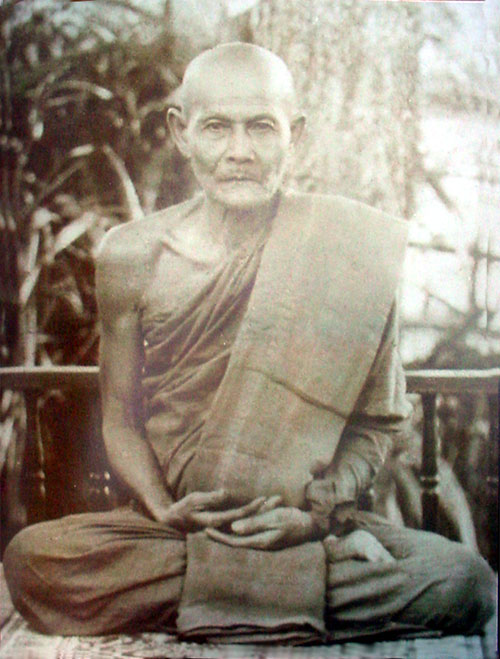
Among the various “swilderness” traditions of Southeast Asia, there is the one that has increasingly attracted the attention of a greater number of Westerners for its originality and sobriety, and has already begun to take root in the West. It is Thailand’s ‘Kammatthāna (Meditation) Forest Tradition’, which came to embody the fundamental ‘anima’ of the current ‘Thai Forest Tradition’, a movement that was catapulted in the early 20th century by the great Master, a native of north-east Thailand, Phra Ajahn Mun Bhūridatta Thera, one of the bulwarks of the Buddhist essence who came to ignite the lost spirit of the ancient ‘Warrior’s Wisdom’, and to which the ‘Thai Forest Tradition’ now owes its spiritual banner.
Born in 1870, son of rice farmers in the northeastern province of Ubon, he ordained himself as a monk in 1892. At that time, the country still suffered the remnants of anarchy caused by the destruction of the Kingdom of Ayudhya in 1767, further worsening the disorganization of the already corrupt monastic system.
There were then two main groups of Buddhism: Traditional Buddhism, which came to be known as Mahanikaya and which included a multiple variety of customs and branches spread throughout the country, already sloppy and with various cults mixed, little already respecting the Pali Canon; and the Dhammayutta Reform Buddhism group, initiated in 1820 by Prince Mongkut who, discontented with the corrupt sloppiness of the monastic situation, decided to reorder themselves among the discipline of the strict Mon, near the Thai-Myanmar border. Its purpose resulted in the alignment of the practice with the teachings of the Pali Canon.
By adopting a more rational and ‘scientific’ approach to the Dhamma, it promoted the eradication of superstitions, a more serious study of the Pali texts and, above all, a new rigour in the monastic Code and Discipline. Finding little appeal in the Traditional group, it was in this group Dhammayutta that later Ajahn Mun came to order himself. His method of practice was solitary and rigorous, giving much more attention to meditation practices than to the theoretical side. He followed the Vināya (monastic discipline) faithfully, and also observed many of the 13 classical dhutanga (ascetic practices), such as eating only what is offered, using habits solely sewn with leftovers, living in the forest, and eating only one meal a day. In search of refuges in the wild forests of Thailand and Laos, he avoided the obligations of accommodating monastic life, thus deciding to devote long hours of the day and night to meditation.
After wandering long years with his Master, who never assured him that this practice would lead to the Noble Achievements, Ajahn Mun decides to go on a lonely journey in search of a Master who could safely show him this path. His quest spanned two decades amid countless challenges and hardships, as he roamed the jungles of Laos, Central Thailand, and Myanmar (Burma), but never found the Master he was looking for. He often realized that he would have to follow the Buddha's example and take savage Nature as his Master, not as a simple measure of conforming to the laws of Nature itself – for Nature itself manifests samsāra (impermanence – transience) – but rather as a means of discerning and attaining in full the truths transcending those same laws. If He wanted to find the way beyond aging, disease, and death, He would have to grasp the lessons of an environment where aging, disease, and death are clearly in evidence. At the same time, encounters with other forest monks indicated to him that learning the lessons of Nature involved more than simply perfecting the skill for physical survival. He would also have to develop discernment so as not to allow himself to be led into undesirable paths in his meditation. And then, with deep determination and responsibility for his task, he returned to a mountainous region of Central Thailand and settled there alone in a cave.
On his long way through the wild recesses of Nature, Ajahn Mun understood that, contrary to the skepticism of both Traditional and Reformation Buddhist groups, the path to Nibbāna (Nirvāna) was not closed. And that the true Dhamma should be found, not in customs, rituals, or texts, but in the well-trained heart and mind. The texts would be indicators for training, no more and no less. The rules of Vināya (discipline), rather than mere external conventions, should take on an important role in physical and mental perseverance. As for the Dhamma texts, the practice should not be just a matter of blind faith, affirmation, or verbalism. Just reading and thinking about the texts, could not offer a proper understanding of their meaning, nor necessarily signify true respect for them. True respect for the texts meant taking them as a challenge: Put your teachings seriously to the test, so as to check where in reality they are true. During the testing of the teachings alongside meditation, the mind would give birth to many unexpected achievements that were not found in the texts. These in turn should also be put to the test, so that in this way one learns gradually by experience and error, to the point of actual and Noble realization. Only then did Ajahn Mun say, "one would have understood the Dhamma."
However, by ensuring that the path to the Noble Achievements and Nibbāna was open, Ajahn Mun returns to the northeast and despite his reserved nature, with his unique and wholesome posture, was increasingly attracting admirers and disciples willing to start studying in a more wild environment.
The vital point of this pillar figure of Theravada Buddhism and bulwark of the current “Tai Forest Tradition” is revealed precisely in the balance that within the different traditions, Ajahn Mun himself brought together and fought to combine and accomplish in and around his practice and discipline. He succeeded in harmonizing the rigor of discipline and academic scholarship inspired by the Dhammayutta movement, with the practical side in relation to wild nature, while revitalizing and inspiring the Mahanikaya order.
By this time, another great name had risen, someone who would ground and catapult the whole movement and the essence inspired by Ajahn Mun, throughout the country and beyond. He was the Venerable Ajahn Chah – Phra Bodhinyāna Thera. Like Ajahn Mun, Ajahn Chah was born in Isahn Land, north-east Thailand, more precisely in the so-called ‘Province of the Wise’, Ubon. At the age of nine he decides to leave his family and ordain himself in a local Mahanikaya monastery. At twenty he receives complete ordination as Bhikkhu (monk). As a junior monk, he studies the basics of the Dhamma, discipline, and other scriptures. As he studies the Pali and translates comments from the Dhammapada, he realizes the disparity between his life and that of the monks at the time of the Buddha: they roamed the forests “lonely, impetuous and determined”, and he glued to a book in the study room of a monastery…would he be losing the spirit of resolution? How important was the academic study? Something within him was remaining muffled by limited declinations and approximations at the root of the words themselves. That was certainly not the way to liberation. Dissatisfied with his situation and the sloppiness of local discipline, he decides to go in search of superior guidance in meditation. With another friend he departs in Tudong (pilgrimage of the forest and the wild media).
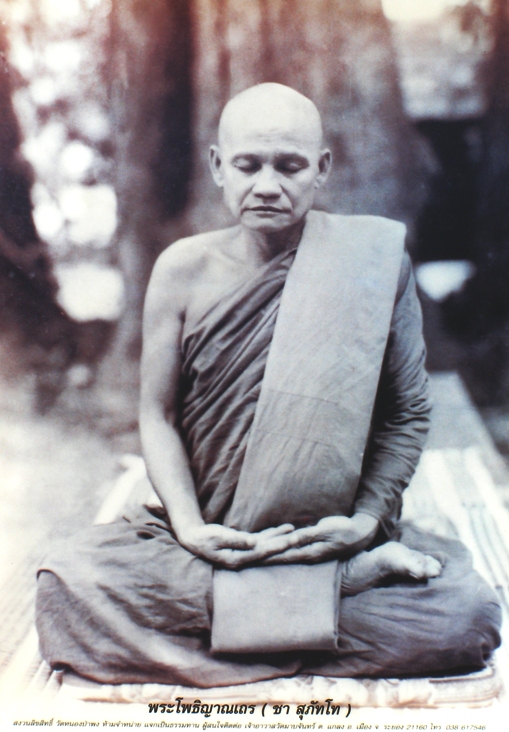
For several years, they walk in the ascetic style, sleeping in forests and caves, going through various challenges and adversities through the jungles of Isahn. They meet some Monasteries and Forest Masters, with whom they spend seasons, assimilating their teachings and practicing meditation. It was during his stay at Wat Kow Wongkot Monastery that for the first time Ajahn Chah heard the name of the monk who would become a legendary figure throughout Thailand, the most revered monk of his generation, Ajahn Mun. A layman then informs him that Ajahn Mun, having been withdrawn in the north for ten years, had returned to Isahn with a large group of monks, settling in the mountains of Sakon Nakon. It is then that Ajahn Chah decides to visit him.
At a critical moment, when doubts flooded his monastic purpose, this was the crucial encounter that profoundly and significantly marked Ajahn Chah until the end of his life. As soon as they entered the monastery of Ajahn Mun, Ajahn Chah was immediately invaded by the quiet and discreet atmosphere. There was something in the monastery like no other – the silence was curiously charged with vibration.
After paying due respects, among several questions, Ajahn Mun asked if they had any doubts regarding the practice. Ajahn Chah answered in the affirmative, expressing his dismay at the study of the texts of the discipline which seemed too detailed to be practiced: It didn't seem possible to keep all the rules. What should be the standard to follow? Ajahn Mun advised it as a basic principle to follow the “Two Guardians of the World”: hiri (a sense of shame) and ottappa (intelligent fear of consequences). In the presence of these two virtues, He said, everything else would follow. Then, he spoke about the training of the three categories of the eight-fold path to improvement: sila (morality), sādhana (concentration) and paññā (knowledge); and on the four Roads to Success and the five Spiritual Powers. With excellent authority, he described the “way things really are” and the path to liberation. Ajahn Chah was perfectly ecstatic.
Later, Ajahn Chah said that despite having spent a tiring day walking, upon hearing Ajahn Mun speak, all the boredom disappeared, his mind became clear, serene, feeling light.
On the second day, Ajahn Mun gave more teachings and Ajahn Chah saw all his doubts go away regarding his future practice. He felt a joy and ecstasy in the Dhamma with never before. Now all he had left was to put his knowledge into practice. Undoubtedly, one of the teachings that most inspired him from these two evenings was the instruction to become Sikkhibhuto himself, i.e. “Truth Witness”. But the most enlightening explanation, which gave it the necessary support for the practice that had hitherto escaped it, was the distinction between the mind itself and all the transitory states that appear and disappear within it. Ajahn Mun said they are mere states. By not understanding this point, we take them as real, identifying them with the mind itself. They are only transitory states.
On the third day, Ajahn Chah paid respects and left with a heart full of a golden inspiration, which he would never leave until the end of his life.
It is said that Ajahn Mun, interpreting the dream of a senior disciple, intuited that Ajahn Chah was the monk who would spread the seed of the Forest Tradition throughout the Mahanikaya order and create a firmer Sangha, with the foundation of several monasteries throughout the Province and Country. And so it happened.
In 1954, Ajahn Chah returned to Ubon province. He is invited to settle in a dense forest near his homeland, Bahn Gor. This uninhabited forest, known as the place of snakes, tigers and ghosts, was in his words the ideal place for a forest monk. As more disciples gathered around him, the Monastery known in his name, Wat Pah Pong, was established.
Maintaining the code inspired by Ajahn Mun and the spirit of the Forest, Ajahn Chah, with his own style of simple, clear and austere teaching, allied a fundamental characteristic to the Kammatthāna Tradition of the Forest. Precisely, a stronger sense of community and group practice, promoting closer contact with the population and even with the foreigner. This is his most distinguished contribution to Tradition. That is, regardless of the factor of the Order, He managed to pass the essence of Tradition, from a condition almost exclusively isolated in distant and reserved recesses or confinement of villages, to a condition broader and closer to the communities in general. On the other hand, in an age of troubled disorientation in which forests are in grave danger of progressive extinction, this more communal movement also helps Tradition to spread more internally, but also internationally. Today, at the beginning of the 21st century, in Thailand alone, there are more than three hundred monasteries of the line of Ajahn Mun and Ajahn Chah scattered throughout the country.
The next step that the Forest Tradition takes is due first of all to Ajahn Chah and then to the entry into the Tradition of the one who was the first Western monk in this Theravada line, Phra Rāja Sumedhācariya – Ajahn Sumedho. It was these two great Grandfathers who sponsored the initial rooting of Tradition in the West. After that, many other Western monks emerged.
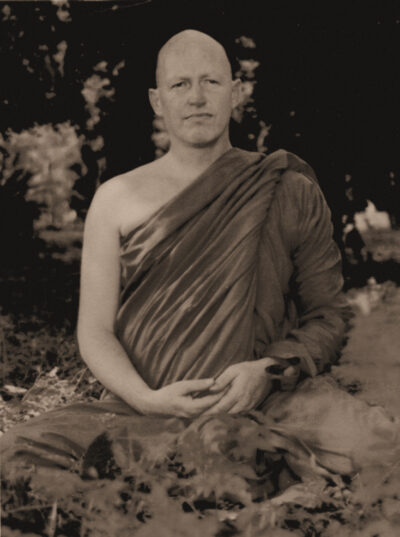
Ajahn Sumedho was born in Seattle, Washington, in 1934. She grew up in an Anglican family with an older sister. Between 1951 and 1953, he studied Chinese and History at the University of Washington. After serving four years as a medical assistant in the U.S. Navy, he returns to the University and completes the Bachelor of Arts degree in Far Eastern Studies.
The studies introduce him to Buddhism through reading, while the period of service in the Navy leads him to contact the “Buddhist Society of Japan”. In 1961, he re-registered for the Master of Arts degree in South Asian Studies at the University of California, Bekerley, where he graduated in 1963.
Disillusioned and dissatisfied with the dogmatism of the Western religion, he decided in 1966 to travel to Thailand to practice meditation in Wat Mahathat, Bangkok. Not long after, he took ordination as a novice monk in a remote part of the country, Nong Khai, until he received full ordination in 1967.
A year of solitary practice follows. Although fruitful, this period showed him the need for a teacher who could guide him more actively. A furtuitous encounter with a visiting monk led him to search for his meditation master in Ubon Province at the Forest Monastery in Wat Pah Pong, the monastery of Ajahn Chah. He accepts Ajahn Chah as his preceptor, thus becoming his disciple and remaining under his intimate guidance for ten years.
In 1975, Ajahn Chah allowed him to lead a small community of monks not far from Wat Pah Pong, thus founding a “Monastery of Forest Tradition” for Western monks, Wat Pah Nanachat, “International Forest Monastery”, where Westerners could come and train in English. In 1976, Ajahn Sumedho made a trip to America to visit his parents, but not without a stopover in England, and was invited to stay in a small Buddhist Monastery in Hampstead, London. A second visit to this monastery in 1977, accompanied by Ajahn Chah, became the beginning of his residence in England, precisely in the Hampstead Vihāra (Vihāra - residence or small Monastery), along with three other monks.
In 1981 he was awarded the degree of Upajjhaya (Upajjhāya: preceptor) this is a monk over ten years of age, who has the authority to confer complete monastic ordination. Since then he has ordained hundreds of aspirants of various nationalities.
Since then, with great initial efforts and much will, four Monasteries of this Tradition were founded in England and eight more in the rest of the Western world, thus having the Tradition of the Forest of Thailand, found fertile soil in Portugal, establishing the Sumedhārāma Buddhist Monastery.
Within Theravada Buddhism is the line ‘The Kammatthāna Tradition (Meditation) of the Forest’, which today, better known as the ‘Thai Forest Tradition’, had as its fundamental milestone the movement inspired and founded by a monk from north-east Thailand in the 20th century, Phra Ajahn Mun Bhūridatta Thera (Phra – in pāli, Venerable). His impulse took a new breath and revitalized the practical teaching of the Buddha, illuminated again the forgotten path to Nibbāna (Nirvāna in Sanskrit) and raised what in ancient cultures was known as the “Wisdom of the Warrior”.
Going back to the past, the tradition of forest meditation goes even further than the Buddha's own time. It was customary to see in these ancient times, in India and in the region of the Himalayas, many who, in seeking the way of spiritual liberation, left the life of the city and village in search of a refuge in the mountain and in the virgin forest. In an act of renunciation of worldly riches and values, this was the ideal place, because the Forest offered a harsh natural space in which the few who could be found there were either the "crazy", the outcasts, or the spiritual renouncers. It was a dimension apart from material influence and cultural norms and thus the propitious site for the cultivation of higher spiritual qualities, which allowed transcending these same limitations.
At the age of 29, Prince Siddhārta Gautama leaves the palace where he grew up and heads to the forest for the purpose of training the disciplines of Yoga. The story is known of how, dissatisfied, he left his masters, looking for his own way. He did so, after which he came to the realization of the essential truth he called ‘The Middle Way’, precisely under the shadow of the bodhi tree, off the Nerañjarā River, where Bodh-Gayā is now located in Bihar State, India.
As far as historical records can confirm, it is reported that, a few months after the Buddha died, supposedly in the 5th century BC, a large Council of Elders was convened to formalise and establish the teachings and monastic rules, in the standard form of the vernacular Pālibhasa – “The Language of Texts.” One hundred years later, the Second Council meets again to verify the whole teaching and to create a general consensus on the code and doctrine. It was then that the great schism and division between the two “vehicles” took place. Most of the group wanted to change certain rules and came to give rise to the Mahāyāna – Great Vehicle, known as North Buddhism, which spread mainly to Tibet (Vajrayāna branch), China, Korea and Japan. The minority of the group were more cautious about the proposed modifications, preferring to remain faithful to the strict simplicity of the teachings and not extrapolate the Dhamma as it had been bequeathed by the Buddha to his original Disciples. It was from this minority group of Theras (in Pāli language – Elders) that 130 years after this “Council”, the Theravada school, Hīnayāna – Small Vehicle, emerged, characterised by being the most conservative, also known as South Buddhism and spreading to the South and Southeast, initially India and then Sri Lanka, Burma, Thailand, Laos, Vietnam, Malaysia and Indonesia.
By 250 BC, during the reign of Emperor Aśoka (§) (273-236), there were already several divergent lines and schools throughout the Indian Sub-Continent. It was then that the third Buddhist Council presided over by Venerable Moggaliputta Tissa Maha Thera met, under the fundamental patronage of the Grand Emperor and where several missions were decided, sent both into and out of India.
In the course of time, there were other missionary groups that dispersed to other Southeast Asian countries, from India and Sri Lanka, such as Burma and later Thailand, Cambodia and Laos.
Despite the geographical dispersion, the continuous retrospection to the standard values of the Pāli Canon was maintaining the central verticality of Tradition, with all the respect and reverence for the way of life and discipline that the Buddha performed in the forest. This Forest Tradition has been the model that has been subsisting despite the many ups and downs over the centuries. Tradition sometimes faded in Sri Lanka and there came monks from Thailand to help her up. Other times it was in Thailand the weakening and there went the monks of Burma to give their breathGo and encourage. This has been the case for centuries, supporting and helping each other, maintaining the original character of ‘religion’ on the surface.
By the mid-19th century, Buddhism in Thailand had acquired a rich variety of regional traditions and practices. However, the general body of his spiritual life had become degraded along with the sloppiness and corruption of monastic discipline, with Dhamma teachings mixed with nebulous tantric and animistic vestiges, allied to the fact that rare were already those who practiced meditation. To make matters worse, there was already a widespread opinion, both on the side of the degenerate fraction and even more so by the "scholars" of orthodoxy, that it was no longer possible to perform nibbāna (Nirvāna), or even reach the initial states of jhāna (meditative absorption).
This was a situation that the revivalists of the Forest Tradition refused to accept. And it was at the same time one of the reasons why they were "catalogued" by independents and agitators by the ecclesiastical hierarchy of the time, in addition to the disdain that many of them showed for the "study monks" of the Theravada line itself by asserting that "wisdom is not taken from books".
This contrast is another crucial point, and precisely the mature ground for something new to emerge. A few, dissatisfied with the current situation, such as the Buddha 2500 years earlier, felt the need to go further. Not neglecting the study of the Canon, they then turned their eyes and their lives again to the wild corners of the forests and mountains, as if retreating to their own inner Nature, seeking there contemplative retreat and meditation in contact with the natural environment, thus bringing to light the practice of inner realization and discovery.
Among the various “swilderness” traditions of Southeast Asia, there is the one that has increasingly attracted the attention of a greater number of Westerners for its originality and sobriety, and has already begun to take root in the West. It is Thailand’s ‘Kammatthāna (Meditation) Forest Tradition’, which came to embody the fundamental ‘anima’ of the current ‘Thai Forest Tradition’, a movement that was catapulted in the early 20th century by the great Master, a native of north-east Thailand, Phra Ajahn Mun Bhūridatta Thera, one of the bulwarks of the Buddhist essence who came to ignite the lost spirit of the ancient ‘Warrior’s Wisdom’, and to which the ‘Thai Forest Tradition’ now owes its spiritual banner.
Born in 1870, son of rice farmers in the northeastern province of Ubon, he ordained himself as a monk in 1892. At that time, the country still suffered the remnants of anarchy caused by the destruction of the Kingdom of Ayudhya in 1767, further worsening the disorganization of the already corrupt monastic system.
There were then two main groups of Buddhism: Traditional Buddhism, which came to be known as Mahanikaya and which included a multiple variety of customs and branches spread throughout the country, already sloppy and with various cults mixed, little already respecting the Pali Canon; and the Dhammayutta Reform Buddhism group, initiated in 1820 by Prince Mongkut who, discontented with the corrupt sloppiness of the monastic situation, decided to reorder themselves among the discipline of the strict Mon, near the Thai-Myanmar border. Its purpose resulted in the alignment of the practice with the teachings of the Pali Canon.
By adopting a more rational and ‘scientific’ approach to the Dhamma, it promoted the eradication of superstitions, a more serious study of the Pali texts and, above all, a new rigour in the monastic Code and Discipline. Finding little appeal in the Traditional group, it was in this group Dhammayutta that later Ajahn Mun came to order himself. His method of practice was solitary and rigorous, giving much more attention to meditation practices than to the theoretical side. He followed the Vināya (monastic discipline) faithfully, and also observed many of the 13 classical dhutanga (ascetic practices), such as eating only what is offered, using habits solely sewn with leftovers, living in the forest, and eating only one meal a day. In search of refuges in the wild forests of Thailand and Laos, he avoided the obligations of accommodating monastic life, thus deciding to devote long hours of the day and night to meditation.
After wandering long years with his Master, who never assured him that this practice would lead to the Noble Achievements, Ajahn Mun decides to go on a lonely journey in search of a Master who could safely show him this path. His quest spanned two decades amid countless challenges and hardships, as he roamed the jungles of Laos, Central Thailand, and Myanmar (Burma), but never found the Master he was looking for. He often realized that he would have to follow the Buddha's example and take savage Nature as his Master, not as a simple measure of conforming to the laws of Nature itself – for Nature itself manifests samsāra (impermanence – transience) – but rather as a means of discerning and attaining in full the truths transcending those same laws. If He wanted to find the way beyond aging, disease, and death, He would have to grasp the lessons of an environment where aging, disease, and death are clearly in evidence. At the same time, encounters with other forest monks indicated to him that learning the lessons of Nature involved more than simply perfecting the skill for physical survival. He would also have to develop discernment so as not to allow himself to be led into undesirable paths in his meditation. And then, with deep determination and responsibility for his task, he returned to a mountainous region of Central Thailand and settled there alone in a cave.
On his long way through the wild recesses of Nature, Ajahn Mun understood that, contrary to the skepticism of both Traditional and Reformation Buddhist groups, the path to Nibbāna (Nirvāna) was not closed. And that the true Dhamma should be found, not in customs, rituals, or texts, but in the well-trained heart and mind. The texts would be indicators for training, no more and no less. The rules of Vināya (discipline), rather than mere external conventions, should take on an important role in physical and mental perseverance. As for the Dhamma texts, the practice should not be just a matter of blind faith, affirmation, or verbalism. Just reading and thinking about the texts, could not offer a proper understanding of their meaning, nor necessarily signify true respect for them. True respect for the texts meant taking them as a challenge: Put your teachings seriously to the test, so as to check where in reality they are true. During the testing of the teachings alongside meditation, the mind would give birth to many unexpected achievements that were not found in the texts. These in turn should also be put to the test, so that in this way one learns gradually by experience and error, to the point of actual and Noble realization. Only then did Ajahn Mun say, "one would have understood the Dhamma."
However, by ensuring that the path to the Noble Achievements and Nibbāna was open, Ajahn Mun returns to the northeast and despite his reserved nature, with his unique and wholesome posture, was increasingly attracting admirers and disciples willing to start studying in a more wild environment.
The vital point of this pillar figure of Theravada Buddhism and bulwark of the current “Tai Forest Tradition” is revealed precisely in the balance that within the different traditions, Ajahn Mun himself brought together and fought to combine and accomplish in and around his practice and discipline. He succeeded in harmonizing the rigor of discipline and academic scholarship inspired by the Dhammayutta movement, with the practical side in relation to wild nature, while revitalizing and inspiring the Mahanikaya order.
By this time, another great name had risen, someone who would ground and catapult the whole movement and the essence inspired by Ajahn Mun, throughout the country and beyond. He was the Venerable Ajahn Chah – Phra Bodhinyāna Thera. Like Ajahn Mun, Ajahn Chah was born in Isahn Land, north-east Thailand, more precisely in the so-called ‘Province of the Wise’, Ubon. At the age of nine he decides to leave his family and ordain himself in a local Mahanikaya monastery. At twenty he receives complete ordination as Bhikkhu (monk). As a junior monk, he studies the basics of the Dhamma, discipline, and other scriptures. As he studies the Pali and translates comments from the Dhammapada, he realizes the disparity between his life and that of the monks at the time of the Buddha: they roamed the forests “lonely, impetuous and determined”, and he glued to a book in the study room of a monastery…would he be losing the spirit of resolution? How important was the academic study? Something within him was remaining muffled by limited declinations and approximations at the root of the words themselves. That was certainly not the way to liberation. Dissatisfied with his situation and the sloppiness of local discipline, he decides to go in search of superior guidance in meditation. With another friend he departs in Tudong (pilgrimage of the forest and the wild media).
For several years, they walk in the ascetic style, sleeping in forests and caves, going through various challenges and adversities through the jungles of Isahn. They meet some Monasteries and Forest Masters, with whom they spend seasons, assimilating their teachings and practicing meditation. It was during his stay at Wat Kow Wongkot Monastery that for the first time Ajahn Chah heard the name of the monk who would become a legendary figure throughout Thailand, the most revered monk of his generation, Ajahn Mun. A layman then informs him that Ajahn Mun, having been withdrawn in the north for ten years, had returned to Isahn with a large group of monks, settling in the mountains of Sakon Nakon. It is then that Ajahn Chah decides to visit him.
At a critical moment, when doubts flooded his monastic purpose, this was the crucial encounter that profoundly and significantly marked Ajahn Chah until the end of his life. As soon as they entered the monastery of Ajahn Mun, Ajahn Chah was immediately invaded by the quiet and discreet atmosphere. There was something in the monastery like no other – the silence was curiously charged with vibration.
After paying due respects, among several questions, Ajahn Mun asked if they had any doubts regarding the practice. Ajahn Chah answered in the affirmative, expressing his dismay at the study of the texts of the discipline which seemed too detailed to be practiced: It didn't seem possible to keep all the rules. What should be the standard to follow? Ajahn Mun advised it as a basic principle to follow the “Two Guardians of the World”: hiri (a sense of shame) and ottappa (intelligent fear of consequences). In the presence of these two virtues, He said, everything else would follow. Then, he spoke about the training of the three categories of the eight-fold path to improvement: sila (morality), sādhana (concentration) and paññā (knowledge); and on the four Roads to Success and the five Spiritual Powers. With excellent authority, he described the “way things really are” and the path to liberation. Ajahn Chah was perfectly ecstatic.
Later, Ajahn Chah said that despite having spent a tiring day walking, upon hearing Ajahn Mun speak, all the boredom disappeared, his mind became clear, serene, feeling light.
On the second day, Ajahn Mun gave more teachings and Ajahn Chah saw all his doubts go away regarding his future practice. He felt a joy and ecstasy in the Dhamma with never before. Now all he had left was to put his knowledge into practice. Undoubtedly, one of the teachings that most inspired him from these two evenings was the instruction to become Sikkhibhuto himself, i.e. “Truth Witness”. But the most enlightening explanation, which gave it the necessary support for the practice that had hitherto escaped it, was the distinction between the mind itself and all the transitory states that appear and disappear within it. Ajahn Mun said they are mere states. By not understanding this point, we take them as real, identifying them with the mind itself. They are only transitory states.
On the third day, Ajahn Chah paid respects and left with a heart full of a golden inspiration, which he would never leave until the end of his life.
It is said that Ajahn Mun, interpreting the dream of a senior disciple, intuited that Ajahn Chah was the monk who would spread the seed of the Forest Tradition throughout the Mahanikaya order and create a firmer Sangha, with the foundation of several monasteries throughout the Province and Country. And so it happened.
In 1954, Ajahn Chah returned to Ubon province. He is invited to settle in a dense forest near his homeland, Bahn Gor. This uninhabited forest, known as the place of snakes, tigers and ghosts, was in his words the ideal place for a forest monk. As more disciples gathered around him, the Monastery known in his name, Wat Pah Pong, was established.
Maintaining the code inspired by Ajahn Mun and the spirit of the Forest, Ajahn Chah, with his own style of simple, clear and austere teaching, allied a fundamental characteristic to the Kammatthāna Tradition of the Forest. Precisely, a stronger sense of community and group practice, promoting closer contact with the population and even with the foreigner. This is his most distinguished contribution to Tradition. That is, regardless of the factor of the Order, He managed to pass the essence of Tradition, from a condition almost exclusively isolated in distant and reserved recesses or confinement of villages, to a condition broader and closer to the communities in general. On the other hand, in an age of troubled disorientation in which forests are in grave danger of progressive extinction, this more communal movement also helps Tradition to spread more internally, but also internationally. Today, at the beginning of the 21st century, in Thailand alone, there are more than three hundred monasteries of the line of Ajahn Mun and Ajahn Chah scattered throughout the country.
The next step that the Forest Tradition takes is due first of all to Ajahn Chah and then to the entry into the Tradition of the one who was the first Western monk in this Theravada line, Phra Rāja Sumedhācariya – Ajahn Sumedho. It was these two great Grandfathers who sponsored the initial rooting of Tradition in the West. After that, many other Western monks emerged.
Ajahn Sumedho was born in Seattle, Washington, in 1934. She grew up in an Anglican family with an older sister. Between 1951 and 1953, he studied Chinese and History at the University of Washington. After serving four years as a medical assistant in the U.S. Navy, he returns to the University and completes the Bachelor of Arts degree in Far Eastern Studies.
The studies introduce him to Buddhism through reading, while the period of service in the Navy leads him to contact the “Buddhist Society of Japan”. In 1961, he re-registered for the Master of Arts degree in South Asian Studies at the University of California, Bekerley, where he graduated in 1963.
Disillusioned and dissatisfied with the dogmatism of the Western religion, he decided in 1966 to travel to Thailand to practice meditation in Wat Mahathat, Bangkok. Not long after, he took ordination as a novice monk in a remote part of the country, Nong Khai, until he received full ordination in 1967.
A year of solitary practice follows. Although fruitful, this period showed him the need for a teacher who could guide him more actively. A furtuitous encounter with a visiting monk led him to search for his meditation master in Ubon Province at the Forest Monastery in Wat Pah Pong, the monastery of Ajahn Chah. He accepts Ajahn Chah as his preceptor, thus becoming his disciple and remaining under his intimate guidance for ten years.
In 1975, Ajahn Chah allowed him to lead a small community of monks not far from Wat Pah Pong, thus founding a “Monastery of Forest Tradition” for Western monks, Wat Pah Nanachat, “International Forest Monastery”, where Westerners could come and train in English. In 1976, Ajahn Sumedho made a trip to America to visit his parents, but not without a stopover in England, and was invited to stay in a small Buddhist Monastery in Hampstead, London. A second visit to this monastery in 1977, accompanied by Ajahn Chah, became the beginning of his residence in England, precisely in the Hampstead Vihāra (Vihāra - residence or small Monastery), along with three other monks.
In 1981 he was awarded the degree of Upajjhaya (Upajjhāya: preceptor) this is a monk over ten years of age, who has the authority to confer complete monastic ordination. Since then he has ordained hundreds of aspirants of various nationalities.
Since then, with great initial efforts and much will, four Monasteries of this Tradition were founded in England and eight more in the rest of the Western world, thus having the Tradition of the Forest of Thailand, found fertile soil in Portugal, establishing the Sumedhārāma Buddhist Monastery.

 EN
EN  PT
PT