

Who we are
Sumedharama is a Buddhist monastery of the Theravada Tradition, located near Ericeira, Portugal. The Monastery, established in 2018, is inspired by Ajahn Sumedho. In 1975, Ajahn Sumedho, following the instructions of his teacher Ajahn Chah (1918-1992), founded the first non-Thai monastery. Since 1975, many non-Thai monasteries have been established in Europe, Australasia, North and South America, and Thailand itself, all following what they understand as the practice and spirit of Wat Nong Pah Pong and affiliated Thai monasteries as they were in the time of Ajahn Chah.
The aim of the Monastery is to provide the monastics of the Thai Forest Tradition with a simple and peaceful place of practice, and they share the aspiration to achieve Nibbana, freedom from all suffering.
Sumedharama is also open to guests and visitors and is an environment where individuals, families and residents have the opportunity to be in touch with the principles of Buddha's teachings, and to build themselves up by cultivating these qualities in their own lives.
Ajahn Vajiro
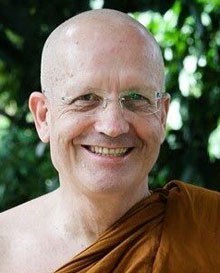
He was born in Kuala Lumpur, Malaysia in 1953.
He studied in England and obtained a bachelor's degree in economics in 1974. In 1979, he met Ajahn Chah and Ajahn Sumedho when they paid a visit to Hampstead Vihara in Oakenholt, England.
In 1979 he left for Thailand and in June 1980 received Upasampada (higher ordination) from Ajahn Chah. Ajahn Vajiro returned to England in 1984, where he assisted several monasteries. He spent three years in retreat in the ‘Sanghaloka’ hermitage in Australia, then returned to Amaravati in 2001 at the invitation of Luang Por Sumedho, and was one of the monks who contributed most to the life and well-being of this monastery.
In 2010, he was formally invited to help establish a monastery of the Forest Tradition in Portugal. Ajahn Vajiro undertook to lead the initiative and from the beginning of Vassa 2012 (July), he moved to Portugal. He is one of the founding monks of the legal institution that represents the Monastery: Theravada Buddhism of the Forest – Religious Community and is today the Abbot of Sumedharama Buddhist Monastery.
Ajahn Dhammiko
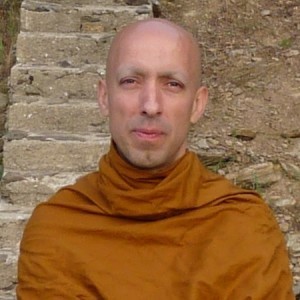
He was born in Lisbon in 1969. With a strong connection to the countryside and nature, he was part of the Nature Conservation Association – Quercus from 1990 to 1995. He served in Santarém and Coimbra from August 1991 to April 92. Finishes the Agricultural Engineering Course in Castelo Branco – 1998, specialising in the areas of Organic Agriculture, Aromatic/Medicinal Plants and Essential Oils. He worked at the CNIG – Centro Nacional de Informação Geográfica (National Geographic Information Centre) from April 98 to November 2001, collaborating with the Civil Protection, Firefighters and Forestry Services of the time.
While still at university, he intensifies his interest in spirituality and the search for Truth, gradually impelling him to greater meditative recollection, Yoga and Buddhism. The inner need for the indispensable discipline to deepen meditation toward spiritual liberation led him to enter Buddhist monastic life.
In April 2003 he visited the Amaravati Buddhist Monastery in England for the first time. A second visit in September, after which, in April 2004, he returned to Amaravati already with the purpose of ordering himself as a blank Anagarika postulant. He was ordained as Samanera (novice monk) on 15 May 2005 and as Bhikkhu (full ordination) on 9 July 2006, being his Preceptor – Ajahn Sumedho.
Since 2013 he has been in Portugal at the Sumedhārāma Buddhist Monastery, having been one of the founding monks of the legal institution representing the Monastery: Forest Theravada Buddhism – Religious Community.
Ajahn Appamado
He was born in Portugal in 1976. He studied Marine Biology and Environmental Engineering at the University of Faro, where his research and spiritual approach to life comes to take an increasingly prominent role, leading Ajahn Appamado to take an interest in meditation and spiritual practices, both Western and Eastern. Through his research, he became aware of the Amaravati Buddhist Monastery in England and decided to visit it. He was part of the support team of the 2005 Winter Retreat, after which he returned to Portugal for five months to organize his life so that he could return to the monastery for a longer period.
Thus, in September 2005 he is again in England, going first to visit the Buddhist Monastery Cittaviveka (Chithurst). At that time he decided to order himself as Anagarika, which happened in December of that year in Amaravati.
Nine months later, having seen the benefits of monastic practice, he asked the Pabbajja (ordained as a novice monk). He was ordained as Bhikkhu in July 2009, with Luang Por Sumedho as his preceptor.
He lived in the Amaravati Monastery until 2012, when he moved to Portugal, being an integral part of the Sumedharama Sangha.

 EN
EN  PT
PT