

Meditation and Silence Retreat - from 29 November to 1 December 2025
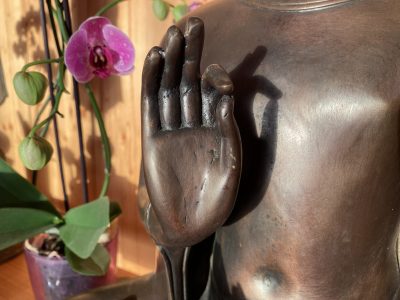


In the rainy season (Vassa), in Asia, (the period corresponding to summer in Europe) the monks undertake to stay in a certain place for three months.
The story goes that at the end of this period, the Buddha allowed the monks to look for fabric with which they could patch up their old habit or even make a new one. The fabrics that the monks collected consisted of rags that had been thrown away. Over time people, realising this need, began to hang fabric from the trees so that the monks could ‘find’ them. The custom then developed so that not only pieces of cloth were left on the trees, but also the habits already made. People saw here an opportunity to make offerings of other requirements to monks, as a gesture of support and appreciation of their practice. The ceremony was called Kathina, which is the name of the loom that monks use to sew their habits with the fabrics offered.
In this same ceremony the monks offer lectures on the Dhamma, and there is also a period where people have the opportunity to meet and talk to the monks more informally. In this event it becomes quite evident the interconnection of the lay community with the monastic community and how both benefit from this dynamic.
On the evening of December 31, 2024 we will have a New Year's Eve in Sumedharama.

We will begin our celebrations with the usual puja/meditation at 7:30 p.m., after which there will be a Dhamma Lecture and space for questions and answers. Everyone will then have the possibility to remain in meditation until midnight, when we will sing songs, thus peacefully celebrating the entrance to the New Year 2025.
There is no need to make an appointment, everyone is welcome to celebrate this passage in this way, with an introspective and recollective attitude.
The celebration ends shortly after midnight.

This session is organised by Appamāda Association and will take place on Saturday, 23rd of November,
from 17:30 to 19:00 (WET).
There will be a small Guided Meditation, followed by a talk and space for questions and answers.
You can participate through the Zoom link:
https://us02web.zoom.us/j/88225048377?pwd=41zvrrnmEsPE9sP0Kz3lI141y1EXsL.1
or
Meeting ID: 882 2504 8377
Passcode: 102030
All are welcome

In the rains season (Vassa) in Asia (a period which correlates to summer in Europe), the monks undertake the determination to remain in one place for three months.
According to the scriptures, at the end of this period, The Buddha allowed the monks to ask for cloth with which they could amend their cloths or even make new clothes.
The cloth the monks collected named of rags that had been discarded. As time went by, people, realizing this need, stuck hanging fabric from trees, so that the monks could ‘find’ them.
The custom then developed in such a way that not only pieces of fabric were left on the trees, but also ready made clothes.
People spotted the opportunity to make offers of other requirements to the monks, as a gesture of support and appreciation for their practice.
named a ceremony called ‘Kathina’ was created, ‘Katina’ being the name of the loom that the monks use to sew their clothes using the cloth offered. During this ceremony, the monks offer Dhamma talks and there is also a time for people to meet and talk with the monks in a more informal way. In this event, the connection between the lay community and the monastic community becomes evident, as well as their benefit from this dynamic.
In the rainy season (Vassa), in Asia, (the period corresponding to summer in Europe) the monks undertake to stay in a certain place for three months.
The story goes that at the end of this period, the Buddha allowed the monks to look for fabric with which they could patch up their old habit or even make a new one. The fabrics that the monks collected consisted of rags that had been thrown away. Over time people, realising this need, began to hang fabric from the trees so that the monks could ‘find’ them. The custom then developed so that not only pieces of cloth were left on the trees, but also the habits already made. People saw here an opportunity to make offerings of other requirements to monks, as a gesture of support and appreciation of their practice. The ceremony was called Kathina, which is the name of the loom that monks use to sew their habits with the fabrics offered.
In this same ceremony the monks offer lectures on the Dhamma, and there is also a period where people have the opportunity to meet and talk to the monks more informally. In this event it becomes quite evident the interconnection of the lay community with the monastic community and how both benefit from this dynamic.

Directed by Ajahn Dhammiko

This retreat will take place in the house of St. Ignatius Retreats, in Sintra, Portugal.
It is organised by Helena Gallis.
Registration is now closed.

Saturday, 2024-08-17,
12:00-13:30
(Lisbon and London time – WEST/BST)
Meeting ID: 834 4386 9973
Password: 123
The talk will be in English, ending with a Q&A session.
Sumedharama Buddhist Monastery
Caminho do Vale Grande 59,
Fonte Boa dos Nabos
2655-464 Ericeira, Portugal
email: sangha@sumedharama.pt

 EN
 PT